
Wherever We Are, The Holy Child Finds Us
FAITH & CULTURE · SPECIAL FEATURE
Filipinos Across Europe Keep One of the World's Oldest Devotions Gloriously, Joyfully Alive

In 1521, Ferdinand Magellan gifted a small wooden statue of the Holy Child Jesus — the Santo Niño — to Queen Juana of Cebu upon her baptism, marking the arrival of Christianity in the Philippines. When Miguel López de Legazpi rediscovered that same image in 1565, it became the founding miracle of the Basilica Minore del Santo Niño — the oldest Christian relic in the country.
More than 500 years later, the Santo Niño remains the most beloved symbol of Filipino faith and culture — celebrated by Filipinos in every corner of the world. Wherever they go, the Holy Child goes with them.
And today — in Dublin churches, Oslo halls, and a quiet Welsh town on the North Wales coast — He is still being carried, still being celebrated, and still making Filipinos feel, no matter how far from home, that they are exactly where they belong.
In this special feature, Roots & Wings Magazine brings you three remarkable stories of that devotion alive and flourishing across Europe.
In Ireland, 27 extraordinary years of devotion have built the oldest Filipino religious community in the country — now an Official Chapter of the Basilica Minore del Santo Niño de Cebu.
In Norway, devotees from across the country gathered in Oslo under the theme "United in Faith and Love,” with visiting priests from Rome and a celebration as warm and joyful as any held under the Philippine sun.
And in the United Kingdom, history was made quietly and beautifully in Abergele, North Wales, with the very first Filipino-language Mass at St. Theresa's Catholic Church, celebrated on the Feast of the Holy Child himself.
Three countries. Three communities. One unbreakable faith.
The Holy Child is with us. Wherever we are — He is with us.
Viva Santo Niño. Pit Señor!
📍 IRELAND
Santo Nino Ireland - 27 Years of Faith, Community, and the Filipino Spirit That Refuses to Fade

Picture this. Dublin, January 2000. A small group of Filipinos — most of them domestic workers employed at foreign embassies in Donnybrook — gather quietly in a church on Berkeley Road. There is no grand production. No elaborate procession. No hundreds-strong congregation. Just a handful of people, far from home, united by something that no ocean crossing could ever diminish: their faith in the Santo Niño.
Twenty-seven years later, that quiet gathering has become the oldest Filipino religious devotion in Ireland — a vibrant, joyful, deeply rooted community that grows stronger with every passing year.
This is not just a story about religion. It is a story about identity, resilience, and what happens when a people refuse to let go of who they are — no matter where in the world life takes them.
Viva Santo Niño!
How It All Began
The man who planted the first seed was Fr. Patrick Keenan, OCD — an Irish priest with a deep respect for Filipino faith and culture. From 2000 to 2009, he led the annual Feast Day Mass and the simple but sacred entrance procession of the statue of the Holy Infant of Prague at St. Joseph's Church, Berkeley Road. Year by year, the devotion grew — quietly, steadily, the way the most enduring things always do.
Then in 2010, the community placed its trust in a couple who would go on to give the next 15 years of their lives to this devotion: Marlou and Lorna Patindol.
What they built is nothing short of extraordinary.
From a founding team of eight couples and two individuals, they grew Santo Niño Ireland into a structured, thriving community of 12 couples and five individual coordinators — each deeply committed to planning and implementing every aspect of the Santo Niño calendar throughout the year. Under their stewardship, the devotion did not merely survive. It flourished.
But perhaps their greatest achievement came at the close of their tenure. Before stepping down as Head Coordinators at the 25th Annual Feast in January 2024, Marlou and Lorna secured something that would anchor the devotion for generations to come: Official Chapter status with the Basilica Minore del Santo Niño de Cebu. Achieved in March 2024 through a special ceremony conducted by Fr. Basilio Sungataon, this recognition connected Santo Niño Ireland directly to the heart of global devotion — a milestone fifteen years in the making.
True to character, they did not simply hand over the reins. They trained new leaders, established clear structures, and ensured the community was ready. As one devoted member quietly observed — "They are still working behind the scenes."
That, perhaps, says everything about who Marlou and Lorna Patindol are.
A New Chapter, The Same Heart
Leadership of Santo Niño Ireland now rests with Efren and Remy Caballero — the current Head Coordinators serving their two-year term, which concludes in June 2026. In keeping with the By-Laws of the Cofradia, new Head Coordinators are always chosen from within the existing team — people who are not only deeply familiar with the devotion but who bring fresh perspectives from their involvement in other Filipino community groups across Ireland.
Tradition continues. The flame is passed. The devotion endures.
The 27th Feast: In Santo Niño, We Are One
This year's theme could not have been more perfectly chosen: "In Santo Niño, We Are One."
The 2026 Feast followed the beautiful rhythm that has defined every celebration — nine days of novena and Masses, the recitation of the rosary, two outdoor processions, the blessing of children, and the deeply moving Sinulog offering. These are not simply activities on a programme. They are the pillars of a living tradition — rituals that link the Filipino community in Dublin to centuries of devotion across the archipelago.
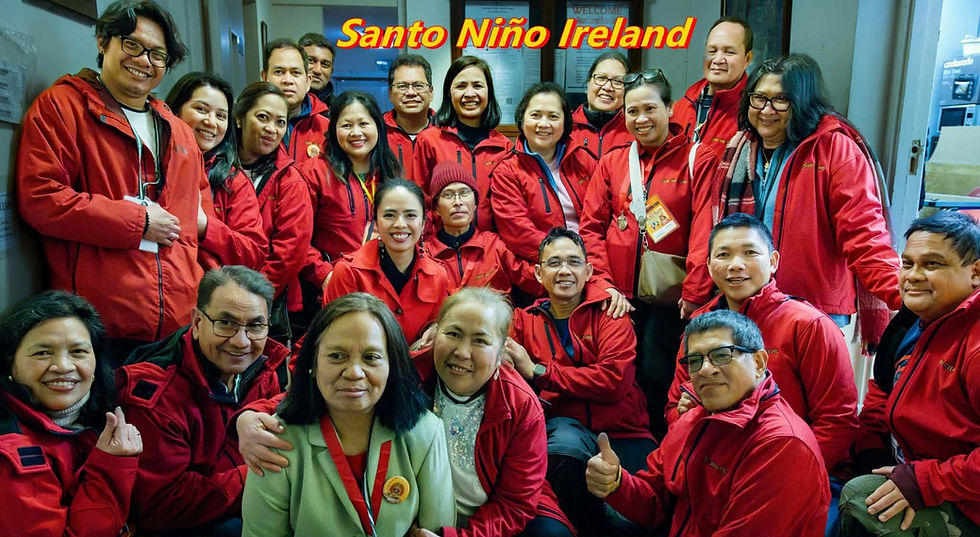
But what made this year's celebration truly unforgettable was the performance of the Kaplag Dancers. These remarkable young people had represented Santo Niño Ireland at the European Fiesta Señor Celebration in Venice, Italy in April 2025 — where they brought home numerous awards and made every Filipino in Ireland stand a little taller with pride. To see them perform on home ground, in Dublin, was a moment of pure joy. A full circle. A community celebrating itself at its very best.
More Than a Feast — A Lifeline to Home
Ask any Filipino in Ireland what the Feast of Santo Niño means to them and you will not get a simple answer. Because it is never simple. It is the smell of incense and candles that takes you back to a church in the provinces. It is the sound of the Sinulog that makes your heart remember something your mind had almost forgotten. It is the feeling — rare and precious when you live abroad — of being completely, unapologetically yourself.
Santo Niño Ireland has worked tirelessly to make that feeling real and lasting. In 2014, a Santo Niño statue — an exact replica of the original image, carved by the Basilica's official wood carver and commissioned by Augustinian Friar Fr. Jose Seidel Jr. — was brought to Ireland. In January 2017, a Santo Niño Shrine was constructed at St. Joseph's Church, Berkeley Road, with a special Enthronement Ceremony that drew the community together in celebration.
Every First Friday of the month, Filipinos from different social, civic, and religious groups gather for the ongoing devotion — a monthly heartbeat that keeps the community connected, not just to their faith, but to each other.
The celebrations follow the same dates as in the Philippines. The activities mirror those at home. Because that is the point. Distance changes your address. It does not change who you are.
What the Sinulog Says

The Sinulog is, at its heart, an act of offering. A prayer in movement. But it is also something more — a declaration of identity so vivid and so beautiful that no one who witnesses it can mistake its origins.
The rhythm. The costume. The statue held aloft. The forward and backward motion that mirrors the flow of the Pahina River in Cebu. Every element speaks of the Philippines — of a people whose faith and culture are inseparable, who express devotion not only in words and prayer but in the whole body, the whole spirit.
For Filipinos living far from home, this matters enormously. It says: we are still here. We have not forgotten. And we are proud.
As Marlou Patindol wrote in the January 2012 Souvenir Programme — in words that still ring out across every celebration: "I believe there is a need to celebrate our faith. No matter where in the Philippines one comes from, no matter what language one was taught as a child, no matter what state in life one is in right now — there is a need to show that we can be together in expressing our gratitude and faith as one."
Looking Forward: The Road to 2029
The community has its eyes set firmly on the horizon. The 30th Anniversary in 2029 is already being anticipated with great excitement — a landmark celebration that will honour the past, give thanks for the present, and set the course for the next generation of devotees.
Because that is what makes Santo Niño Ireland truly special. It has never been only about the Filipinos who are here today. It has always been about the children and grandchildren who will carry this devotion forward — who will one day stand in a Dublin church and feel, in the flicker of candlelight and the sound of the Sinulog, exactly what it means to be Filipino.
Twenty-seven years ago, a handful of people gathered in faith. Today, that faith fills a church, dances in the streets, and reaches all the way back to Cebu.
Some seeds, when planted with enough love, grow into something that can never be uprooted.
Viva Santo Niño. Pit Señor!
Santo Niño Ireland holds its monthly devotion every First Friday of the month at St. Joseph's Church, Berkeley Road, Dublin. All are welcome — Filipino and non-Filipino alike.
R&W Magazine extends its warmest gratitude to Lorna Patindol and Remy Caballero for their time, their generosity, and their passion in sharing the beautiful story of Santo Niño Ireland with our global readership. Lorna and Remy, your dedication to this community — and your willingness to keep telling its story — is itself an act of devotion. Maraming salamat.
📍 NORWAY
The Feast of Señor Sto Niño - Norway
by Amabelle Mitzi Salarda No-ot, Contributor, Norway

The Feast of Señor Sto. Niño, celebrated on January 17 in Oslo, was once again a resounding success and a deeply moving expression of faith for the Filipino Catholic community in Norway. This year’s celebration carried the beautiful theme “United in Faith and Love,” perfectly reflecting the spirit of unity and devotion shared by all who took part. Devotees from different communities all over Norway came together, making the occasion truly vibrant and grace-filled.
The celebration was made even more meaningful by the presence of two visiting priests from Rome: Monsignor Jonas Achacoso of the Vatican Supreme Court and Rev. Fr. Gregorio Adolfo of the Augustinian Order. Their presence brought added spiritual depth to the Eucharistic celebration and served as a powerful reminder of the universality of our Catholic faith.
The success of the Sto. Niño Feast would not have been possible without the dedication and tireless efforts of the organizers. The Our Lady of Mount Carmel Chaplaincy Pastoral Council, led by Rev. Fr. Johan Dumandan, worked diligently to ensure a prayerful and well-organized celebration. The cooperation and service of the Hermanas of 2026, headed by the Lucero sisters, also played a vital role, exemplifying true devotion and panata to the Holy Child.
Beyond the solemnity of the liturgy, the celebration was filled with joy and laughter. The festive atmosphere was made even more exciting through the raffle draw, where lucky winners were greeted with loud cheers and joyful applause—adding a fun and communal spirit to the gathering and creating lasting memories for all present.
More than a cultural event, the Feast of Sto. Niño continues to draw us back to our roots and reminds us that this devotion, now more than 500 years old, is a celebration of faith that transcends time and place. It is a living testimony to the faith handed down through generations and kept alive in our hearts wherever we may be.
As we give thanks for this year’s successful celebration, we also look forward with excitement and hope to an even bigger and more joyful Sto. Niño Feast next year, as our community continues to grow in faith and love.
VIVA PIT SEÑOR
📍 UK
A Historic Celebration of Faith, Culture, and Community: The First Filipino Mass
By Jonathan Pico, Country Editor Wales, UK

The celebration of the first Mass in the Filipino language at St. Theresa’s Catholic Church in Abergele was more than a milestone — it was a moment of joyful reflection, shared memory, and renewed belonging. What unfolded was not simply a liturgical event, but a gathering that gently wove together faith, culture, and community in a way that felt both familiar and deeply moving.
The Mass was celebrated by Father Edson Paguntalan, a Mill Hill Missionary from the Philippines. His presence and leadership carried a profound sense of home for many in attendance. Hearing the prayers, responses, and hymns in a language shaped by shared roots allowed the community to worship not only with their voices, but with their stories. It served as a quiet reminder that faith travels with people — that even far from home, devotion remains alive, personal, and deeply rooted.
The presence of members of the Liverpool Filipino Catholic Community further enriched the occasion. Their regular Filipino Mass has long been a source of strength and inspiration, and their participation reflected how Filipino communities, though spread across different towns and cities, remain spiritually connected and united in faith.
For that afternoon, St. Theresa’s Church became a space where cultures met and complemented one another. Father John Bosco Bukomba, parish priest of the church, reflected that when Filipinos gather, it naturally feels like a celebration — a sentiment that perfectly captures the spirit of the day. Deacon David Gozzard, who assisted in the Mass, shared that although he did not understand the language, the liveliness of the liturgy and the voices of the choir spoke clearly of joy and reverence. The music of the Filipino Voice Choir – North Wales carried the prayers beyond words, allowing everyone present to feel included in the sacred moment.
Those who gathered came from the towns of Rhyl, Abergele, and Colwyn Bay in North Wales, joined by friends from Liverpool and Chester in England. What united them was not geography, but a shared desire to worship together and reconnect with something deeply familiar. In that space, the Mass became an expression of belonging — proof that community is not defined by place, but by presence.
Celebrated on the Feast of the Holy Child, Señor Santo Niño, the Mass echoed themes of joy, simplicity, and trust. There was no grand occasion being marked, yet the day revealed a deeper truth: simply gathering as one people, in faith and hope, is already a celebration.
For many, the moment carried personal resonance. Twenty-five years ago, some of the first Filipino nurses working in the local hospital began their faith journey in this very church before moving on and continuing their worship elsewhere. Returning now felt like coming full circle — a gentle reminder that faith accompanies life’s journeys, adapting and enduring through time.
As the celebration came to a close, what lingered was not only gratitude, but a quiet sense of hope — that this gathering was not an end, but a beginning. A beginning rooted in shared faith, enriched by culture, and sustained by community.
Maraming salamat po, thank you very much, diolch yn fawr—and may God bless us all.


Comments